
Odoo Manufacturing Process: How It Works in a Real Manufacturing Business
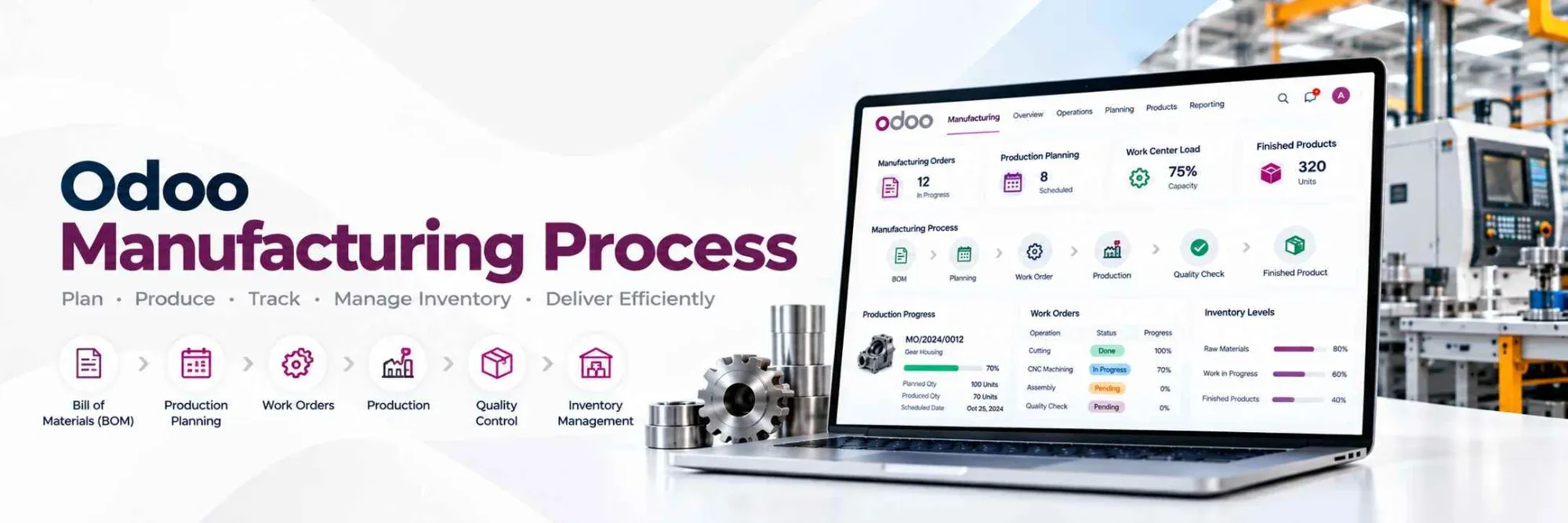
Manufacturing companies need to synchronize raw materials, machines, manpower, and customer deliveries in order to maintain smooth production processes. This can be challenging when each activity is done separately through spreadsheets or any software.
In an Odoo manufacturing process, all manufacturing processes are linked with inventory, purchasing, sales, and accounting.At Lenok Infotech, we guide the companies in finding appropriate Odoo ERP solutions for their manufacturing needs.
What Is the Odoo Manufacturing Process?
Odoo manufacturing process includes all the operations that are carried out to manufacture goods from raw materials. The process begins with the determination of what is to be manufactured and which raw materials will be used. The firm then creates its production plan, manufactures and tracks manufacturing operations, as well as updates its inventory with manufactured products.
A simple manufacturing company may have just a few processes in its process while a manufacturing company manufacturing customised goods may need various production processes, workstations, inspections and movement of materials.Odoo gives an opportunity for businesses to organise the workflow according to their needs, not in the same way for all manufacturing processes.
How Does Manufacturing Function in Odoo?
1. Begin With Product & Bill of Materials (BoM)
To manufacture a certain product, it is necessary to specify its composition at first. In Odoo, such data is stored in a special Bill of Materials (BoM).Let us consider the example of the manufacturer of the wooden chair. This product would need 4 legs, 1 seat, 1 backrest, and a few screws. This composition is documented by BoM.If there is a manufacturing order, it is possible to get the necessary materials for the order using BoM in Odoo.
- BoM should be right since wrong quantity of components would lead to the lack of materials or excess material consumption.
3. Create a manufacturing order
Once the production requirements are clear, the business can create a manufacturing order in Odoo. This record identifies the product to be manufactured, the planned quantity, and the relevant BoM.Suppose the furniture factory needs to produce 100 chairs for a customer. The manufacturing order records that requirement and provides a reference for the team carrying out the work.
As production progresses, the team can update the order according to the configured workflow and record the quantity actually produced.Manufacturing orders can be created manually or generated through supported replenishment workflows when the necessary settings are in place.
4. Track each step in the production process
In some cases, factories will have production processes as one single operation. In other factories, there are multiple steps that need to be tracked individually.
The Odoo platform provides work orders and work centers for companies that have different processes in their production process. For example, a company that produces chairs would go through the process of cutting, assembling, sanding, and finishing. These steps could all be set as operations with the appropriate work center attached.Managers will then have a better grasp on the progress of the manufacturing process. Should an operation take longer than expected, it can be investigated without having to wait until the entire job is delayed.
- Work orders are particularly helpful when the manufacturing process consists of several operations, machines, or groups.
5. Record quality inspection results and completed products
Completion of production processes does not necessarily mean that the product is ready for delivery. Sometimes, there may be some quality control processes required before the products get approved.
Quality Odoo can perform quality control at stages of workflow configuration. For example, the company can inspect the dimensions of the product, its finish surface or assembly of all required components.Once production has been completed, Odoo will record the quantity of the completed items and update the stock based on the configured process. Lot/serial numbers could also be configured if more traceability is needed.
- Actual production quantities are recorded in order to synchronize the inventory records.
What are the Advantages of Implementing Odoo in Manufacturing?
The most significant advantage of Odoo is that it brings departments together. Manufacturing does not occur in a bubble; the purchasing department requires knowledge of what materials are needed, the warehouse requires exact stock levels, and the sales staff needs to know what items are available.
If Odoo is configured properly, it will be helpful for companies to:
- Forecast material requirements: Determine material needs and their replenishment.
- Track manufacturing: Track manufacturing orders and configure manufacturing operations.
- Update inventory levels: Track material use and final products.
- Perform inspection: Do quality checks where necessary.
- Evaluate production costs: Evaluate costs based on component and operations configuration.
This depends on proper product record keeping, proper configuration, and the diligent reporting of transactions by employees.
Is Odoo Right for All Manufacturing Companies?
While Odoo can be configured to accommodate various manufacturing needs, the type of configuration needed is highly dependent on the way a factory works. A company making basic goods may require a basic configuration. A manufacturer that deals with subassembly, work centers, inspection, and traceability will require an advanced configuration.
It is important that companies assess their manufacturing process, inventory management, costing needs, and reporting needs before implementation. It is also important that they simulate common scenarios, such as material shortage, incomplete manufacturing, and product rejection, before going live.
Managing Your Manufacturing Process Using Lenok Infotech
Selecting a manufacturing software does not just involve creation of manufacturing orders. The software should be able to show how material flows inside the manufacturing facility and how the process is being monitored by staff and the management.Lenok Infotech offers Odoo ERP implementation, customisation and integration services to businesses which want to manage their operations using an integrated system. The right software varies depending on how the business is running its manufacturing processes.
Explore Odoo Manufacturing ERP solutions from Lenok Infotech to learn more about supporting your manufacturing workflow with Odoo.
Ready to Transform Your Business?
Talk to Lenok Infotech today to discover the right IT, ERP, cloud, and digital solutions for your business. Get expert guidance tailored to your goals and take the next step with confidence.
Frequently Asked Questions
What is the Odoo manufacturing process?
It is the workflow used to plan production, identify materials, create manufacturing orders, record production activities, and update finished-product inventory.
Can Odoo track raw materials and finished products?
Yes. Odoo integrates Manufacturing with Inventory to record component consumption and finished output. The level of detail depends on the warehouse and manufacturing configuration.
Can Odoo manage multiple production stages?
Yes. Work orders, work centers, and multilevel Bills of Materials can support manufacturing processes involving several operations or subassemblies.
Does Odoo support manufacturing cost analysis?
Yes. Odoo provides manufacturing cost information based on the configured component costs, operations, work centers, and costing settings. Accurate results require reliable production and inventory data.