
Odoo ERP Implementation Company: A Complete Guide for Businesses
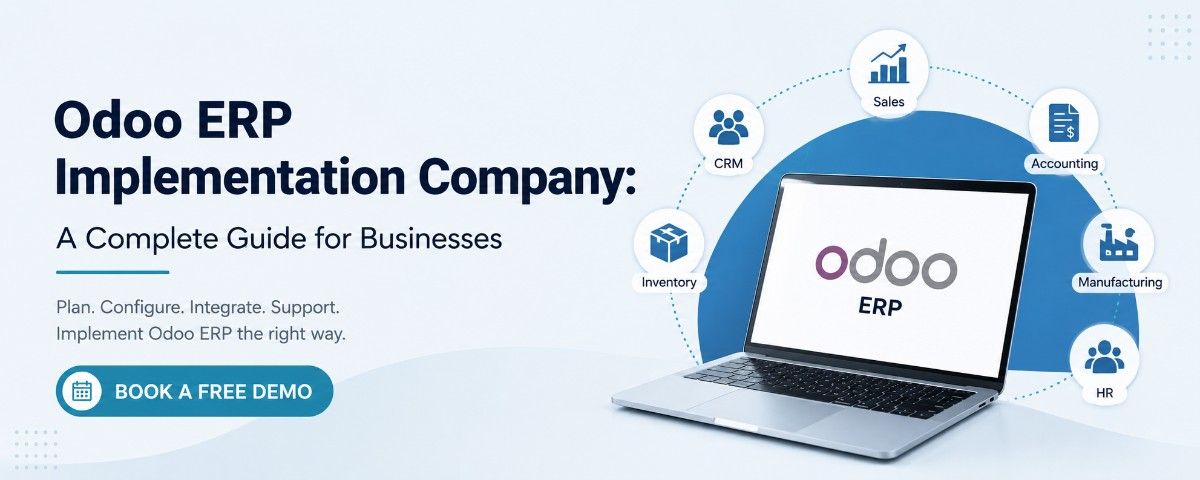
Managing sales, accounting, inventory, CRM, manufacturing, and other operations across disconnected systems can create unnecessary complexity. Odoo ERP brings these functions together on one platform, but successful implementation requires more than installing software.
An Odoo ERP implementation company helps businesses assess requirements, select modules, configure workflows, migrate data, integrate applications, and prepare users. Understanding the implementation process can help businesses make informed decisions before adopting an ERP system.
For a detailed overview of the process, explore Odoo implementation services.
Planning an Odoo ERP Implementation?
What Is an Odoo ERP Implementation Company?
An Odoo ERP implementation company helps businesses deploy and configure Odoo according to their operational requirements. Rather than applying the same setup to every organization, implementation begins by understanding workflows, business objectives, users, and system requirements.
The objective is to determine how Odoo can support existing processes and where configuration, customization, integration, or data migration may be required.
What Does an Odoo Implementation Company Do?
An implementation partner may assist with:
- Business requirements analysis
- Odoo module selection
- System configuration
- Customization and development
- Data migration
- Third-party integrations
- Testing and deployment
- User training
- Post-implementation Odoo support
An ERP consultant can also evaluate business processes, identify gaps, and recommend an appropriate implementation approach.
Why Is Odoo ERP Implementation Important?
Odoo provides modules for CRM, sales, accounting, inventory, manufacturing, purchasing, HR, and other business functions. However, simply activating modules does not guarantee that they will work effectively with existing processes.
A structured implementation helps businesses define workflows, configure permissions, organize data, connect departments, and prepare employees before deployment. It can also identify opportunities to improve manual or disconnected processes.
Implementation becomes particularly important when a business requires data migration, third-party integrations, custom workflows, or multiple Odoo modules.
How Does the Odoo ERP Implementation Process Work?
The exact process varies by business size, industry, and requirements. A typical implementation includes the following stages.
1. Business Requirements Analysis
The implementation team evaluates current workflows, departments, users, operational challenges, and objectives. This helps determine which Odoo functionality is relevant and where processes may need improvement.
2. Module Selection and Configuration
Businesses select modules based on their requirements, such as CRM, Sales, Accounting, Inventory, Manufacturing, Purchasing, or HR.
The selected modules are configured according to workflows, user permissions, reporting requirements, and operational rules.
3. Customization and Integration
Standard Odoo functionality can address many requirements. However, some businesses may require custom development or integrations with e-commerce platforms, payment systems, logistics applications, or other software.
Before adding custom features, businesses should determine whether standard Odoo functionality can meet the requirement. Limiting unnecessary customization can reduce future maintenance complexity.
4. Data Migration and Testing
Existing customer, product, financial, inventory, and other relevant data may need to be transferred into Odoo.
Data should be reviewed and cleaned before migration where necessary. Workflows, reports, integrations, permissions, and migrated information should then be tested before deployment.
5. Training, Go-Live, and Odoo Support
Employees should receive appropriate training before the system goes live. Training helps users understand new workflows and use relevant Odoo features correctly.
After deployment, Odoo support may include troubleshooting, maintenance, configuration assistance, user support, and technical issue resolution.
How Long Does Odoo ERP Implementation Take?
There is no standard implementation timeline. Project duration can depend on:
- Number of users
- Odoo modules required
- Customization
- Third-party integrations
- Data migration
- Testing requirements
- Employee training
A straightforward implementation using standard functionality may require less time than a project involving extensive customization, multiple integrations, and complex data migration.
How to Choose an Odoo ERP Implementation Company?
Businesses should evaluate implementation providers based on more than price. Technical expertise, industry knowledge, implementation experience, and post-launch capabilities are important considerations.
Odoo and Technical Expertise
Look for experience with Odoo modules, configuration, customization, integrations, data migration, and testing. The provider should understand when standard functionality is appropriate and when customization is necessary.
Industry and Business Understanding
Different businesses have different workflows. For example, a manufacturing company may prioritize inventory, purchasing, production, and quality processes, while a service business may focus more heavily on CRM, sales, accounting, and project management.
Implementation and Odoo Support
Evaluate the provider's approach to project planning, testing, training, documentation, troubleshooting, and ongoing Odoo support. Reliable post-launch assistance can help users address issues as business requirements evolve.
Common Odoo ERP Implementation Challenges
Implementation can become complicated when requirements and processes are not clearly defined. Common challenges include:
- Unclear business requirements
- Poor-quality or incomplete data
- Excessive customization
- Integration difficulties
- Insufficient testing
- Limited employee training
- Resistance to process changes
Clear requirements, data validation, thorough testing, and user involvement can help businesses manage these challenges.
How Much Does Odoo ERP Implementation Cost?
There is no fixed implementation cost because every project has different requirements. Factors that can influence the overall cost include:
- Number of users
- Odoo edition
- Required modules
- Customization
- Third-party integrations
- Data migration
- Training
- Odoo support and maintenance
Businesses should evaluate the complete project scope instead of comparing providers based only on the initial price.
Key Takeaways
An Odoo ERP implementation involves more than installing business software. Requirements analysis, module selection, configuration, customization, integration, data migration, testing, training, deployment, and support can all form part of the process.
Understanding these stages helps businesses assess their requirements and determine what expertise they may need before implementing Odoo.
Ready to Explore Odoo ERP?
If you are researching Odoo or preparing for an implementation, understanding your business requirements is an important first step.
Ready to Transform Your Business?
Talk to Lenok Infotech today to discover the right IT, ERP, cloud, and digital solutions for your business. Get expert guidance tailored to your goals and take the next step with confidence.
Frequently Asked Questions
What does an Odoo ERP implementation company do?
An Odoo ERP implementation company helps businesses plan, configure, customize, migrate, test, deploy, and support an Odoo ERP system according to their operational requirements.
How long does Odoo ERP implementation take?
The timeline depends on factors such as users, modules, customization, integrations, data migration, testing, and overall project complexity.
Does Odoo require customization?
Not always. Many requirements can be handled using standard Odoo functionality and configuration. Customization may be needed when specific requirements cannot be addressed effectively through standard features.
What does Odoo support include?
Odoo support can include troubleshooting, maintenance, configuration assistance, user support, issue resolution, and technical assistance after deployment.