
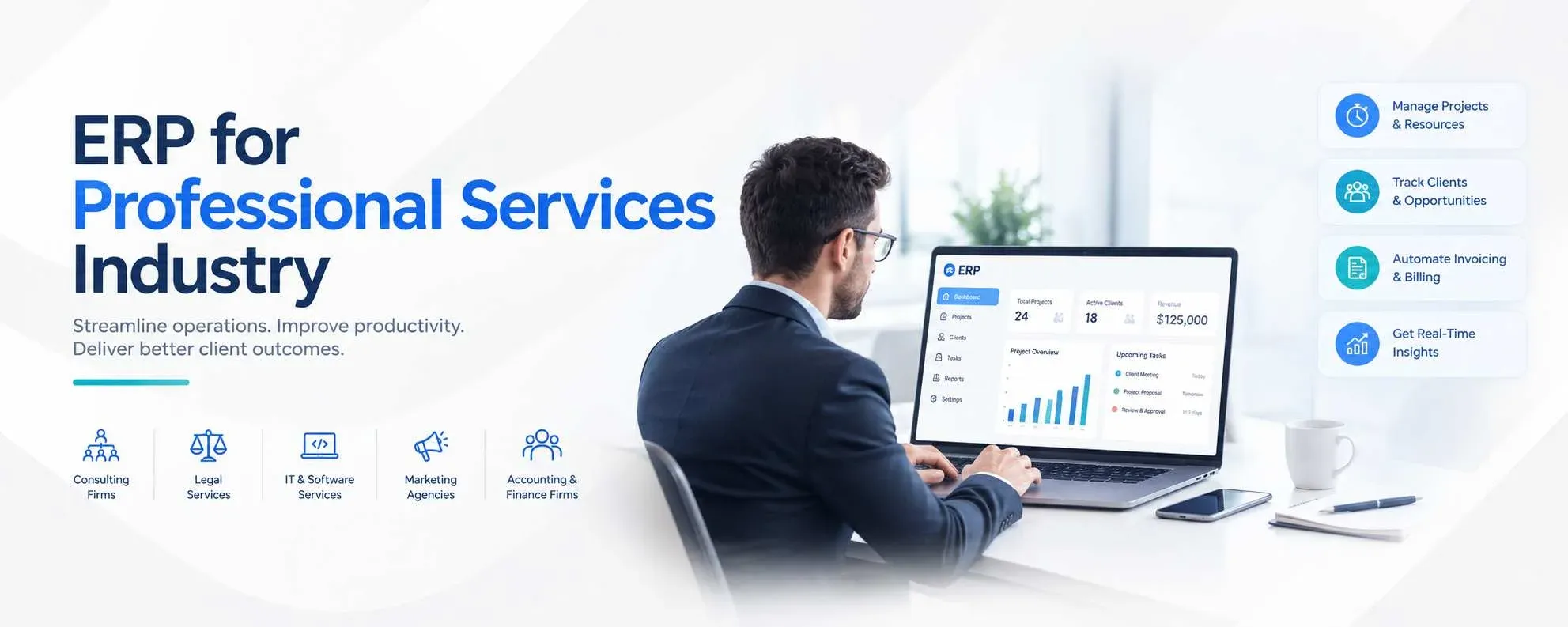
The ERP for Professional Services Industry has become an important business tool for companies that manage clients, projects, employees, working hours, expenses, and billing. Unlike product-based businesses, professional service companies mainly depend on people, skills, time, and client projects. Managing all these areas through separate software can make daily work slow and difficult.
An ERP for Professional Services Industry brings these activities into one connected system. It helps businesses manage their projects, sales, customer relationships, employee work, expenses, invoices, and financial operations from a single platform. There are several ERP solutions available in the market, but each one has different strengths. Below are some of the leading ERP solutions that professional service companies can consider.
Top ERP for Professional Services Industry
Choosing the right ERP for Professional Services Industry depends on the company's size, type of services, number of employees, project structure, and business goals. Some companies need strong project management, while others may give more importance to accounting, CRM, resource planning, or customization.
| Rank | ERP Software | Best Suited For | Main Strength |
|---|---|---|---|
| 1 | Odoo | Consulting, IT, agencies, engineering and service companies | Flexible all-in-one ERP |
| 2 | Microsoft Dynamics 365 | Medium and large service businesses | ERP, CRM and Microsoft ecosystem |
| 3 | SAP Business ByDesign | Growing professional organizations | Enterprise business management |
| 4 | Oracle NetSuite | Growing and international service companies | Cloud ERP and financial management |
| 5 | Acumatica | Project-based service businesses | Cloud ERP and project management |
| 6 | Sage Intacct | Finance-focused service companies | Accounting and financial reporting |
| 7 | ERPNext | Small and medium businesses | Open-source ERP |
| 8 | Infor CloudSuite | Larger organizations | Industry-focused enterprise ERP |
Among these options, Odoo is one of the most flexible ERP solutions for the professional services industry. Its modular structure allows businesses to manage CRM, sales, projects, timesheets, expenses, accounting, invoicing, employees, documents, and other operations within the same platform.
Odoo as an ERP for Professional Services Industry
Odoo is a strong ERP for Professional Services Industry because professional service businesses usually need several business functions to work together. A consulting company, for example, may receive a lead, send a quotation, create a project, assign employees, record working hours, add expenses, and finally send an invoice to the client. Managing each stage separately can create unnecessary work.
With Odoo, these activities can be connected. The sales team can manage the customer opportunity, the project team can handle the work, employees can record their timesheets, and the finance team can manage invoicing and payments. This creates a smoother flow of information between departments and gives managers better visibility into the business.
Odoo Project Management for Professional Services
Project management is one of the most important areas of an ERP for Professional Services Industry. Most professional service companies work on multiple client projects at the same time, and each project may have different tasks, deadlines, employees, and budgets.
Odoo Project helps teams organize projects and tasks in one place. Managers can assign work to employees, monitor project progress, set deadlines, and see which tasks are completed or still pending. This can be especially useful for consulting companies, IT service providers, marketing agencies, engineering firms, and other project-based businesses.
Odoo Timesheets for Billable Work
Time is often the main resource sold by a professional service company. Consultants, developers, designers, engineers, and other professionals may charge clients based on the number of hours spent on a project. For this reason, accurate time tracking is an important part of an ERP for Professional Services Industry.
Odoo Timesheets allows employees to record the time they spend on different projects and tasks. Businesses can use this information to understand employee workload, track billable hours, monitor project costs, and support client billing. Managers can also get a clearer picture of how much time is being spent on each project.
Odoo CRM for Managing Client Relationships
A professional service company needs to manage more than its existing projects. It also needs to find new clients and maintain relationships with existing customers. This makes CRM an important part of an ERP for Professional Services Industry.
Odoo CRM allows sales teams to manage leads, opportunities, customer information, scheduled activities, and follow-ups. When CRM is connected with sales and project management, the transition from a potential client to an active project becomes easier to manage. Sales teams can also keep customer information in one central location.
Odoo Sales and Quotations
Before a professional service project begins, the company usually needs to discuss requirements, prepare a proposal, and provide a quotation. Managing these activities manually can result in delays and communication gaps.
Odoo Sales allows businesses to prepare quotations and manage sales orders while keeping customer information connected to the rest of the ERP. Once a customer accepts a quotation, the information can move into the next stage of the business process. This makes Odoo a practical ERP for Professional Services Industry for companies that handle a large number of service quotations.
Odoo Invoicing and Accounting
Getting paid on time is important for every professional service business. Delayed invoices, incorrect billing, or missing expense information can affect cash flow. An ERP for Professional Services Industry should therefore connect project work with financial operations.
Odoo Accounting and Invoicing can connect financial activities with sales, projects, expenses, and other business operations. Depending on the company's billing process, information such as services provided, project activities, or employee timesheets can support the invoicing process. Finance teams can also manage payments, expenses, financial records, and reports from the same system.
Odoo Expense Management
Professional service employees often spend money while working on client projects. Travel, accommodation, transportation, meals, and other business expenses may need to be recorded and approved before they are included in project costs or client billing.
Odoo Expenses gives employees a way to submit expenses while allowing managers and finance teams to review them. Connecting expenses with projects can also help businesses understand the actual cost of delivering a service. This makes expense management another useful part of Odoo as an ERP for Professional Services Industry.
Odoo Employee and Resource Management
People are the most important resource in many professional service organizations. A company may have consultants, developers, designers, accountants, engineers, project managers, and other specialists working across multiple projects.
Odoo provides employee and HR-related applications that can help businesses manage employee information, attendance, time off, work schedules, and other HR activities. When combined with project and timesheet information, managers can get a better understanding of employee availability and workload.
Odoo for Different Professional Service Businesses
The requirements of a consulting company are not exactly the same as those of an IT company or marketing agency. However, the modular nature of Odoo allows businesses to configure the ERP for Professional Services Industry around their own processes.
| Industry | How Odoo Can Support the Business |
|---|---|
| IT Services | Project management, helpdesk, timesheets, CRM and invoicing |
| Consulting | CRM, quotations, projects, timesheets and client billing |
| Marketing Agencies | Campaigns, projects, tasks, timesheets and expenses |
| Engineering Services | Projects, documents, employee hours and expenses |
| Accounting Firms | Client management, projects, timesheets and accounting |
| Architecture Firms | Project planning, documents, tasks and invoicing |
| Recruitment Firms | CRM, applicants, employees, projects and billing |
| Legal Services | Client management, documents, activities and invoicing |
Why Odoo Can Be a Good Choice for Professional Services
The biggest advantage of Odoo as an ERP for Professional Services Industry is that it can connect different parts of the business instead of treating them as separate systems. A company can manage a customer opportunity, quotation, project, employee time, expenses, invoice, and payment through connected applications.
Odoo is also modular, which means a company does not necessarily have to implement every application at once. Businesses can begin with the modules that solve their current problems and add more applications as their requirements change.
Another important factor is flexibility. Professional service businesses often have unique workflows, approval processes, billing methods, and reporting requirements. Odoo can be configured and customized to match different business processes, making it suitable for organizations that do not want to be restricted to a fixed workflow.
How to Select the Right ERP for Professional Services Industry
The best ERP for Professional Services Industry is not necessarily the software with the longest feature list. The right choice should match the actual way the business operates.
Before selecting an ERP, companies should look at project management, timesheet tracking, CRM, quotations, invoicing, accounting, expense management, employee management, reporting, integrations, customization, and scalability.
It is also important to consider how easily employees can use the system. An ERP may have many advanced features, but if employees find it difficult to use, adoption can become a problem. Businesses should therefore evaluate both functionality and usability before making a final decision.
Ready to Transform Your Business?
Talk to Lenok Infotech today to discover the right IT, ERP, cloud, and digital solutions for your business. Get expert guidance tailored to your goals and take the next step with confidence.
Frequently Asked Questions
1. What are the top 5 ERP systems?
The top 5 ERP systems include Odoo, Microsoft Dynamics 365, SAP Business ByDesign, Oracle NetSuite, and Acumatica. The best choice depends on business size, industry, budget, and requirements.
2. What are the four types of ERP?
The four common types of ERP are cloud ERP, on-premise ERP, hybrid ERP, and two-tier ERP. Each type offers different deployment and management options.
3. What are the five main ERP modules?
The five main ERP modules are accounting and finance, CRM, inventory, human resources, and sales. Professional service businesses may also need project management and timesheet modules.
4. Which ERP is best for the professional services industry?
Odoo is one of the leading ERP options for the professional services industry because it combines CRM, sales, project management, timesheets, expenses, accounting, and invoicing in one system.
5. Why is Odoo good for professional services?
Odoo helps professional service companies manage clients, projects, employees, timesheets, expenses, quotations, and invoices through connected business applications.