
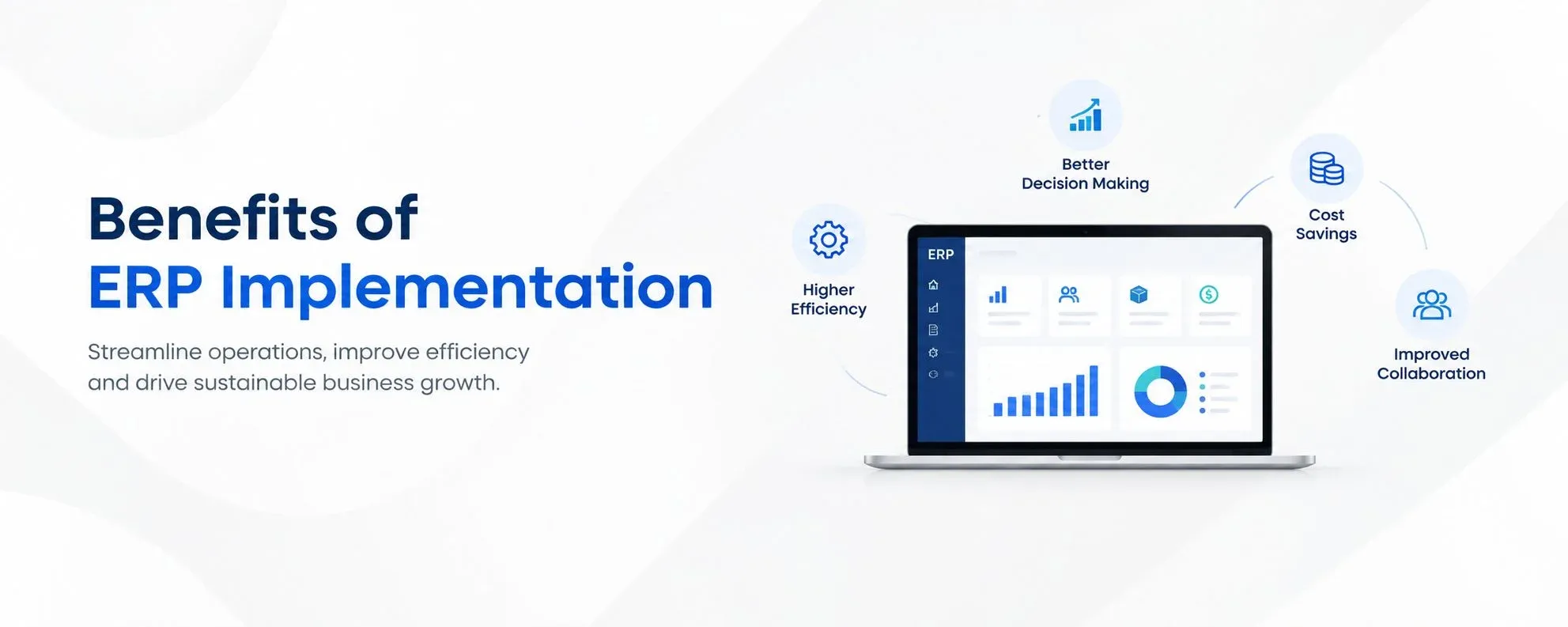
Benefits of ERP implementation can be seen in the way a business manages its daily activities, handles information, serves customers, and plans for future growth. When a company operates with separate tools for accounting, sales, purchasing, inventory, human resources, and other functions, employees often have to move information from one system to another. This can make simple processes take longer than necessary and can make it harder for management to understand what is happening across the business.
An ERP system brings these business functions into a connected environment. More importantly, ERP implementation gives an organization the opportunity to examine how its processes work and improve them while introducing the new system. The result is not just a new software platform, but a more organized way of managing business operations.
A Clearer View of How the Business Operates
One of the practical benefits of ERP implementation is that it gives management a clearer picture of how different parts of the company are connected. Sales activity can influence inventory requirements, purchasing can affect cash flow, and customer payments can influence financial planning. When these activities are managed separately, understanding these relationships can require considerable manual work.
ERP brings related information into a common environment, allowing businesses to look beyond individual departments. This broader perspective can help management understand where delays occur, where resources are being used, and which areas of the operation may require attention.
Fewer Gaps Between Business Processes
Business processes rarely exist in isolation. A completed sale may trigger delivery, inventory movement, invoicing, and accounting activity. If these steps are managed through unrelated applications, there is a greater chance that information will be delayed or missed between one stage and another.
ERP implementation creates connections between these stages. Information entered during one part of a process can become available to the next relevant department. This reduces process gaps and creates a smoother flow of work from the initial transaction through to completion.
Faster Movement of Information Across the Company
In many organizations, employees spend time requesting information from colleagues before they can complete their own work. A purchasing employee may need stock information from the warehouse, while an accounts employee may need transaction details from the sales department.
With an ERP system, authorized users can access the information they need directly from the relevant system records. This can shorten the time spent waiting for internal responses and help business activities move forward without unnecessary interruptions.
More Consistent Customer and Product Records
Businesses accumulate large amounts of customer, supplier, product, and transaction information. When these records are maintained in different locations, inconsistencies can develop over time.
ERP implementation provides a structured way to maintain core business records. When customer or product information is updated, the relevant information can be used across connected processes. This helps businesses maintain greater consistency and reduces the need to maintain the same records independently in several places.
Easier Management of Growing Transaction Volumes
A process that works for a small number of orders may become difficult when transaction volumes increase. More invoices, purchase orders, customers, products, and stock movements can place additional pressure on employees and existing systems.
ERP provides a framework for handling larger volumes of business activity in a more organized manner. Instead of depending heavily on manual tracking, businesses can use defined workflows and system processes to manage increasing operational activity.
Better Use of Management Time
Senior managers often spend time collecting information instead of analyzing it. Preparing reports, checking figures, following up with departments, and comparing separate records can take attention away from strategic responsibilities.
ERP can reduce some of this administrative effort by making business information easier to access and organize. This gives management more opportunity to focus on performance, planning, customer relationships, expansion, and other higher-value responsibilities.
More Structured Purchasing Decisions
Purchasing decisions affect inventory levels, supplier relationships, cash flow, and operating costs. Without sufficient information, businesses may purchase too early, purchase more than required, or fail to replenish important items on time.
ERP implementation connects purchasing information with sales activity, inventory requirements, supplier records, and other relevant data. This provides purchasing teams with better context when deciding what needs to be ordered and when it should be purchased.
Greater Control Over the Order-to-Cash Process
The journey from receiving a customer order to collecting payment involves several business activities. Orders need to be processed, products may need to be allocated or delivered, invoices need to be generated, and payments need to be recorded.
ERP connects these stages within one business workflow. This makes it easier to track the progress of transactions and identify where an order or payment may be delayed. Better visibility across the order-to-cash cycle can improve operational control and financial follow-up.
More Reliable Information for Customer-Facing Teams
Customer service teams need accurate information when answering questions about orders, products, payments, or deliveries. If information is spread across multiple systems, providing a quick answer can become difficult.
ERP gives customer-facing employees access to relevant information through a connected platform. Instead of relying entirely on internal follow-ups, employees can use available system data to understand the customer's current situation and respond more effectively.
Easier Identification of Operational Bottlenecks
Every business has processes that can slow down operations. A purchase approval may take too long, stock may remain unavailable, invoices may be delayed, or a particular workflow may require too many manual steps.
ERP data can help businesses identify these problem areas. By examining transaction history, workflow activity, and process performance, management can determine where delays are occurring and investigate possible improvements.
Better Coordination Across Multiple Locations
Businesses operating from several branches, warehouses, or offices often face additional challenges in maintaining consistent information. Each location may have its own operational activities while management still needs an overall view.
A suitable ERP system can bring information from different locations into a connected environment. This allows businesses to maintain greater visibility across locations while still managing local activities according to their operational requirements.
Stronger Foundation for Digital Transformation
ERP implementation can become an important part of a wider digital transformation strategy. Businesses that continue to depend heavily on manual processes may find it difficult to introduce more advanced technologies later.
Once core business processes are organized digitally, companies have a stronger foundation for additional technologies such as business intelligence, workflow automation, mobile applications, artificial intelligence, and advanced integrations. ERP can therefore serve as a central part of a broader technology environment.
Easier Access to Business Information for Remote Teams
Modern organizations may have employees working from different offices, branches, or locations. Access to consistent business information becomes more important when teams are not working in the same physical environment.
Cloud-based ERP platforms can allow authorized users to access relevant business information from supported devices and locations. This can make collaboration easier and help distributed teams work with the same operational information.
Better Understanding of Business Costs
Understanding where money is being spent is essential for maintaining healthy business operations. Costs can arise from purchasing, inventory, employee expenses, logistics, production, services, and many other activities.
By connecting financial information with operational transactions, ERP can give businesses greater visibility into the relationship between activities and their associated costs. This can help management examine spending patterns and identify areas where better cost control may be possible.
Easier Tracking of Business Performance Over Time
Business performance needs to be evaluated over time rather than only at a single point. Comparing current results with previous periods can reveal changes that may otherwise go unnoticed.
ERP systems maintain historical business information that can be used for performance analysis. Organizations can examine changes in revenue, expenses, sales activity, inventory, purchasing, and other operational indicators to understand how the business is developing.
Reduced Dependence on Individual Employees for Information
In businesses that rely heavily on spreadsheets or personal records, important information may exist primarily with particular employees. If that employee is unavailable, finding the required information can become difficult.
ERP moves important operational information into a structured business system rather than leaving it scattered across individual files. This makes organizational knowledge less dependent on one person's records and creates greater continuity when employees change roles or leave the organization.
Easier Auditing and Transaction Tracking
Businesses may need to review transactions to understand what happened, when it happened, and how a particular process was completed. Searching through emails, spreadsheets, and paper documents can make this process unnecessarily difficult.
ERP systems can provide structured transaction records and workflow information. Depending on the platform and configuration, businesses can use system records to trace activities and review relevant transactions more efficiently.
Better Preparation for Future Business Requirements
A business's requirements rarely remain unchanged. New customers, products, locations, regulations, sales channels, and technologies can create new operational demands.
A well-planned ERP implementation considers not only today's requirements but also the organization's expected direction. Selecting a scalable platform and designing appropriate processes can help the business adapt when its operational needs change.
Improved Coordination Between Finance and Operations
Finance and operations depend on each other, but they often work with different information. Operational teams focus on orders, inventory, purchasing, and customers, while finance teams focus on transactions, payments, expenses, and reporting.
ERP connects these areas so financial information can be linked more closely with operational activity. This gives both sides a better understanding of how day-to-day business decisions affect the financial position of the organization.
Better Visibility Into Supplier Relationships
Suppliers play an important role in businesses that depend on regular purchasing. Managing supplier information across emails, spreadsheets, and separate records can make it difficult to track purchasing history and outstanding activities.
ERP can bring supplier records, purchase orders, receipts, invoices, and related information into a connected process. This provides businesses with a more organized view of supplier activity and can support better purchasing and vendor management.
Supports More Consistent Business Growth
Growth creates opportunities, but it also increases operational complexity. A company that adds customers and revenue without improving its internal processes may eventually experience delays, data problems, and administrative pressure.
ERP implementation provides a structured operating environment that can support business expansion. By organizing core processes early, companies can create a stronger foundation for handling additional activity without relying entirely on manual methods.
The Long-Term Value of ERP Implementation
The real value of ERP implementation is not limited to the first few months after the system goes live. Its long-term benefit comes from creating a more organized operating model that can continue to support the business as its requirements change.
When employees understand the system, business processes are properly configured, data is maintained accurately, and management regularly reviews performance, ERP can become part of the company's everyday operating structure. Over time, this can contribute to better control, more efficient processes, and more informed business decisions.
What Businesses Should Consider Before ERP Implementation
Although ERP offers many potential benefits, businesses should not approach implementation simply as a software purchase. Before selecting a system, the organization should understand its current processes, identify operational problems, define measurable objectives, and determine which functions genuinely require improvement.
The quality of the implementation also matters. Data preparation, employee involvement, training, integrations, testing, customization, security, and ongoing support can all influence the final outcome. A carefully planned implementation is more likely to deliver meaningful improvements than an ERP project focused only on getting the software installed.
Conclusion
The benefits of ERP implementation are closely connected to how effectively a business organizes its people, processes, and information. ERP can help companies create stronger connections between departments, improve visibility into operations, handle growing transaction volumes, strengthen financial and purchasing processes, and provide management with better information for planning.
However, ERP should not be viewed as a solution that automatically fixes every business problem. Its value comes from implementing the right system around clearly understood business requirements and continuously improving the way the organization uses it. When technology and business processes are aligned, ERP can provide a strong foundation for efficient operations and sustainable growth.
Ready to Transform Your Business?
Talk to Lenok Infotech today to discover the right IT, ERP, cloud, and digital solutions for your business. Get expert guidance tailored to your goals and take the next step with confidence.
Frequently Asked Questions
What are the main benefits of ERP implementation?
The main benefits of ERP implementation include improved operational efficiency, centralized data, better financial control, faster reporting, reduced manual work, improved collaboration, stronger inventory management, and better decision-making. An ERP system connects different business functions in one platform, helping companies manage daily operations more effectively.
What is the advantage of ERP?
The main advantage of ERP is that it connects important business processes through a single system. Businesses can manage finance, sales, purchasing, inventory, manufacturing, customer information, and other operations using shared data. This reduces duplication, improves visibility, and helps employees work with more accurate information.
What is an ERP implementation?
ERP implementation is the process of planning, configuring, customizing, testing, and deploying an ERP system within a business. It normally includes business requirement analysis, data migration, system configuration, user training, testing, and final go-live. The goal is to make the ERP system fit the company's business processes.
Why is ERP so important for businesses?
ERP is important because it gives businesses a connected view of their operations. Instead of relying on separate systems and spreadsheets, employees can access information from a centralized platform. This helps management monitor performance, control costs, improve processes, and make decisions using current business data.
What are the five main benefits of ERP?
The five major benefits of ERP are better data management, improved operational efficiency, reduced manual work, stronger financial control, and better decision-making. ERP can also improve collaboration between departments by allowing teams to work with shared and consistent information.
How does ERP improve business efficiency?
ERP improves efficiency by connecting business processes and reducing repetitive manual tasks. Information can move between departments without being entered repeatedly, while automated workflows can handle routine activities. This allows employees to spend more time on important operational and customer-related work.
How does ERP help in decision-making?
ERP provides management with centralized and up-to-date business information. Managers can review financial results, sales activity, inventory levels, purchasing information, and operational performance from one system. This makes it easier to identify problems, compare performance, and make informed business decisions.
Does ERP reduce operational costs?
ERP can help reduce operational costs by automating repetitive work, reducing data errors, improving resource utilization, and providing better control over inventory and purchasing. The actual cost savings depend on the business, ERP solution, implementation quality, and how effectively employees use the system.
How does ERP improve data accuracy?
ERP improves data accuracy by storing business information in a centralized system and reducing the need to enter the same information into multiple applications. Automated processes and validation controls can also reduce common errors caused by manual data entry.
How does ERP improve inventory management?
ERP provides better visibility into stock levels, purchases, sales, warehouse movements, and product availability. Businesses can track inventory more effectively, identify slow-moving items, reduce stock shortages, and make purchasing decisions based on reliable information.
What are the challenges of ERP implementation?
Common ERP implementation challenges include selecting the right system, managing implementation costs, migrating existing data, integrating other applications, adapting business processes, training employees, and managing resistance to change. Proper planning and user involvement can help reduce these challenges.
Is ERP suitable for small businesses?
Yes, ERP can be suitable for small businesses when the system matches their operational requirements and budget. Small companies can use ERP to organize finance, sales, purchasing, inventory, and other processes while creating a foundation that can support future growth.
How long does ERP implementation take?
ERP implementation time varies depending on the size of the business, number of users, modules required, data volume, customization, integrations, and project complexity. A smaller implementation may take a few months, while larger or highly customized projects can take considerably longer.
What happens after ERP implementation?
After implementation, businesses normally move into system monitoring, user support, optimization, and ongoing maintenance. Teams may identify processes that need improvement, introduce additional automation, improve reporting, or add modules as business requirements change.
Is ERP implementation worth the investment?
ERP implementation can be worthwhile when the system addresses genuine business problems and is implemented properly. The value can come from improved efficiency, better information management, stronger process control, reduced manual work, and better visibility across the organization. The return depends on the company's requirements and implementation strategy.