
Why Choose Odoo for Manufacturing Industry? 7 Key Reasons
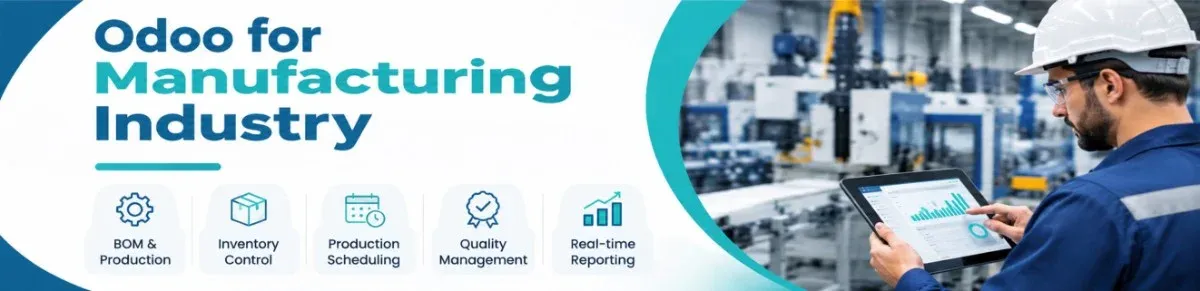
Manufacturing businesses need to coordinate production, inventory, raw materials and quality control efficiently. Odoo for manufacturing industry connects these operations through an integrated ERP platform, helping businesses streamline workflows, control costs and improve productivity.
But why should manufacturers consider Odoo ERP? Here are seven important reasons.
7 Reasons to Choose Odoo for Manufacturing Industry
1. Improve Production Planning and Scheduling
Unplanned production activities can cause machine downtime, delayed orders and inefficient resource utilization. Odoo Manufacturing allows businesses to create manufacturing orders, configure work orders and organize production activities across work centres.
Managers can monitor production progress, identify scheduling conflicts and coordinate activities based on resource availability. This helps improve production planning and manage delivery timelines more effectively.
2. Maintain Better Inventory Control
Raw material shortages can interrupt production and increase purchasing costs. Odoo connects manufacturing with inventory management to provide visibility into raw materials, components and finished products.
Manufacturers can:
- Monitor raw material availability and stock movements.
- Track component consumption during production.
- Manage finished goods and warehouse transfers.
- Configure replenishment rules for required materials.
- Track products using lot and serial numbers.
This helps reduce stock discrepancies and improve material availability.
3. Manage Bills of Materials (BoM) Efficiently
A Bill of Materials defines the components and quantities required to manufacture a product. Managing complex product structures manually becomes difficult when businesses handle multiple product variants or production stages.
Odoo supports single-level and multi-level BoMs, helping manufacturers organize component requirements, product variants and production operations. This makes material planning more structured and helps teams understand what is required for each production order.
4. Strengthen Quality Control and Traceability
Product defects can increase material waste, rework costs and customer complaints. Odoo Quality Management supports quality control points, inspections and quality alerts at different production stages.
Combined with lot and serial number tracking, manufacturers can trace components and finished products when investigating quality issues. This supports better production consistency and product accountability.
5. Connect Manufacturing with Other Business Operations
When purchasing, sales, inventory and production use separate systems, employees often duplicate information and struggle to coordinate decisions.
Odoo connects these operations through integrated applications.
| Odoo Application | Manufacturing Business Benefit |
|---|---|
| Manufacturing | Manage production orders and work orders |
| Inventory | Track raw materials and finished goods |
| Purchase | Coordinate supplier orders and procurement |
| Quality | Organize inspections and quality alerts |
| Maintenance | Schedule equipment maintenance |
| Accounting | Monitor production-related costs |
| Sales | Connect customer demand with production planning |
This integration reduces information gaps and gives managers a clearer view of business operations.
6. Monitor Production Costs and Equipment Performance
Manufacturers need accurate cost information to understand profitability. Odoo provides manufacturing order cost analysis based on component consumption and configured production operations.
Its reporting capabilities can also include Overall Equipment Effectiveness (OEE) measures, depending on the Odoo version and configuration. These insights help managers evaluate work-centre performance, investigate downtime and identify operational bottlenecks.
7. Adapt to Changing Manufacturing Requirements
As manufacturing businesses expand, they may introduce new products, production lines or operational processes. An ERP system should accommodate these changes without creating disconnected workflows.
Odoo offers configurable applications, production routing options, product variants and customization possibilities. Businesses can extend their ERP workflows as requirements evolve, although complex operations may require additional development or integration.
Manufacturers in specialized sectors can also explore Odoo for food manufacturing to understand how ERP workflows can support ingredient inventory, batch traceability, production planning and quality control.
For a deeper understanding, explore our guide to Odoo manufacturing ERP features, processes and solutions.
Why Choose Lenok Infotech for Odoo Manufacturing ERP?
Successful ERP implementation requires more than software installation. Manufacturers must evaluate existing workflows, configure inventory rules, establish product structures and connect relevant business applications.
Lenok Infotech helps businesses explore Odoo ERP implementation, customization and integration based on their operational requirements. A well-planned implementation can help manufacturers streamline workflows, improve business visibility and get greater value from their ERP investment.
Looking to improve your manufacturing operations? Discuss your requirements with the Lenok Infotech team.
Ready to Transform Your Business?
Talk to Lenok Infotech today to discover the right IT, ERP, cloud, and digital solutions for your business. Get expert guidance tailored to your goals and take the next step with confidence.
Frequently Asked Questions
1. Is Odoo good for manufacturing companies?
Yes. Odoo supports production planning, manufacturing orders, work orders, inventory management, quality control and maintenance. Lenok Infotech can help businesses evaluate its suitability for their manufacturing workflows.
2. Which ERP is best for manufacturing?
The best ERP depends on production complexity, business size, budget and integration requirements. Odoo, SAP, Microsoft Dynamics and Oracle NetSuite are options worth comparing. Businesses should evaluate their operational needs before choosing a system.
3. What is manufacturing in Odoo?
Odoo Manufacturing is an ERP application that manages Bills of Materials, manufacturing orders, work orders, work centres and production activities through an integrated platform.
4. Is Odoo 100% free?
Odoo offers a free Community Edition under an open-source licence and a One App Free online plan. However, additional applications, Enterprise features, hosting choices and implementation services may involve costs.
5. Is Odoo better than Zoho?
It depends on the business requirements. Odoo offers dedicated manufacturing features such as BoMs, work orders and production planning. Zoho provides a different range of business applications, so manufacturers should compare the specific features and integrations they need.
6. Is Odoo better than Tally?
Odoo and Tally serve different business requirements. Odoo offers integrated ERP applications for manufacturing, inventory, sales and other operations, while Tally is widely used for accounting and financial management. The right choice depends on the scope of operations.
7. Who is the biggest competitor of Odoo?
Odoo competes with several ERP providers, including SAP, Microsoft Dynamics, Oracle NetSuite and ERPNext. The closest alternative depends on the company's size, industry and software requirements.
8. What software is used in manufacturing?
Manufacturers commonly use Enterprise Resource Planning (ERP), Manufacturing Execution Systems (MES), Material Requirements Planning (MRP), inventory management and quality management software. Odoo integrates several manufacturing and business management functions within one platform.
9. What is ERP for manufacturing?
Manufacturing ERP is software that connects production planning, inventory, procurement, quality control and financial operations. It helps businesses coordinate resources, monitor workflows and make informed operational decisions.