ERP Odoo Solutions by Lenok Infotech | Complete Guide to Features, Modules, Use Cases & Business Benefits
ERP Odoo is a powerful all-in-one business management system that helps companies simplify and automate their daily operations. From accounting and sales to inventory, HR, and manufacturing, it brings everything into a single platform for better control and visibility. Businesses use ERP Odoo to reduce manual work, improve workflow speed, and make smarter decisions in real time. It is a flexible solution that fits both small businesses and large enterprises looking for scalable growth.
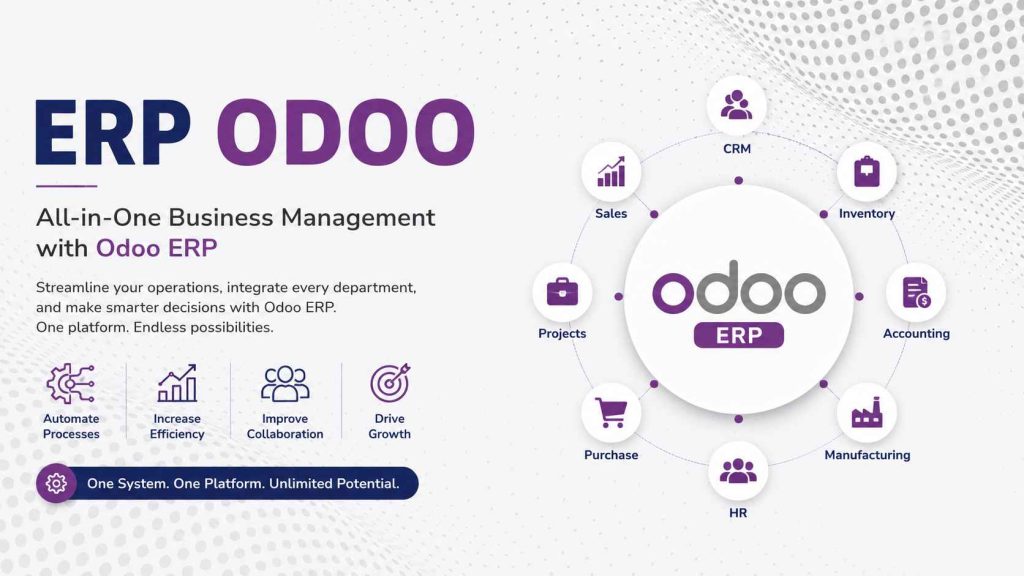
Functional Odoo Modules for Every Department
| Department | Odoo Module | Key Functionality |
|---|---|---|
| Sales | Odoo Sales | Manages quotations, sales orders, customer invoicing, and the complete sales cycle. |
| Accounting | Odoo Accounting | Handles invoicing, bookkeeping, tax compliance, bank reconciliation, and financial reporting. |
| Inventory | Odoo Inventory | Manages stock movements, warehouse operations, inventory valuation, and real-time product tracking. |
| Human Resources | Odoo HR | Maintains employee records, attendance, leave management, payroll, recruitment, and performance tracking. |
| Manufacturing | Odoo Manufacturing (MRP) | Supports production planning, bills of materials (BoM), work orders, quality control, and shop floor management. |
| CRM | Odoo CRM | Tracks leads, opportunities, customer communication, and sales pipeline management. |
| Purchase | Odoo Purchase | Automates supplier management, RFQs, purchase orders, procurement workflows, and vendor performance. |
| Marketing | Odoo Marketing | Manages email marketing, SMS campaigns, social media marketing, event marketing, and automation tools. |
End-to-End ERP Use Cases in Odoo Platform
Odoo ERP is used by businesses to manage all core operations in one place. From sales to finance, every department can work together without switching between multiple tools. This makes daily work faster, more organized, and easier to control.
Here are the main end-to-end use cases of Odoo ERP:
→ Sales management from lead capture to final invoice generation
→ Purchase management including vendor orders and procurement tracking
→ Inventory control with real-time stock updates and warehouse management
→ Accounting operations such as billing, expense tracking, and financial reports
→ CRM workflow to manage leads, follow-ups, and customer communication
→ HR operations including employee records, attendance, and payroll processing
→ Manufacturing process handling from planning to production execution
→ Project management to track tasks, deadlines, and team performance
→ Marketing automation for email campaigns and customer engagement
→ E-commerce integration for online store management and order processing
Odoo ERP connects all these processes in a single system, so data flows smoothly between departments. This reduces manual work, avoids errors, and helps businesses make faster decisions.
Ideal Users of Odoo ERP System
| User Type | How They Use Odoo ERP | Benefit |
|---|---|---|
| Startups | Manage sales, CRM, and basic business operations from a single platform. | Easy implementation with lower operational costs. |
| Small Businesses | Handle daily sales, accounting, inventory, and customer management. | Saves time and minimizes manual work. |
| Medium Businesses | Connect HR, finance, sales, purchasing, and inventory departments. | Improves collaboration and streamlines workflows. |
| Large Companies | Manage multiple branches, departments, users, and business processes. | High scalability with centralized control. |
| Retail Stores | Track billing, inventory, POS transactions, and customer orders. | Faster checkout and real-time stock visibility. |
| Manufacturing Units | Plan production, manage bills of materials, and monitor work orders. | Increases production efficiency and reduces waste. |
| Service Companies | Manage projects, customer relationships, timesheets, and invoicing. | Ensures organized and efficient service delivery. |
| Online Businesses | Manage eCommerce orders, payments, shipping, and customer support. | Simplifies online business operations. |
| Accounting Teams | Handle invoices, vendor bills, taxes, bank reconciliation, and reports. | Provides accurate financial management. |
| HR Teams | Manage employee records, attendance, leave requests, payroll, and recruitment. | Simplifies workforce management and HR processes. |
Odoo ERP Solutions by Lenok Infotech
Lenok Infotech offers complete Odoo ERP solutions to help businesses manage sales, accounts, inventory, HR, and CRM in one system. This makes business operations simple, fast, and well organized.
With Odoo ERP solutions by Lenok Infotech, companies can reduce manual work, improve accuracy, and get real-time data for better decisions. It helps both small and large businesses run smoothly and efficiently.
Lenok Infotech also provides easy setup, customization, and support to match different business needs.
Frequently Asked Questions (FAQs) About ERP Odoo
1. What is ERP Odoo?
ERP Odoo is an all-in-one business management software that helps companies manage sales, accounting, inventory, human resources, manufacturing, CRM, purchasing, and other business operations through a single integrated platform.
2. Is Odoo ERP good for small businesses?
Yes. Odoo ERP is an excellent choice for small businesses because it is affordable, user-friendly, and highly scalable. Businesses can start with the required modules and add more features as they grow.
3. What are the main features of Odoo ERP?
Odoo ERP includes powerful modules such as Sales, CRM, Accounting, Inventory Management, Human Resources, Manufacturing (MRP), Purchase, Marketing Automation, Project Management, and eCommerce.
4. Why do companies use ERP Odoo?
Companies use ERP Odoo to automate business processes, reduce manual work, improve operational efficiency, increase productivity, and manage all departments from one centralized platform.
5. Is Odoo ERP cloud-based?
Yes. Odoo ERP is available as both a cloud-based solution and an on-premise deployment, allowing businesses to choose the option that best matches their operational and security requirements.