
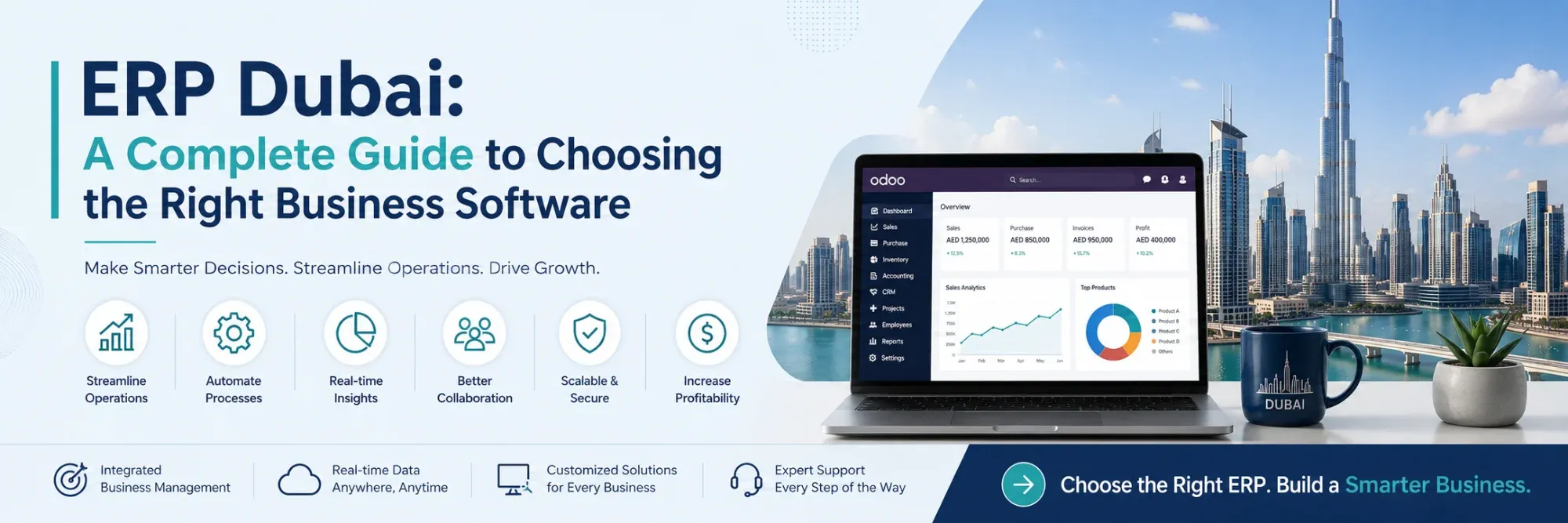
Managing operations with disconnected spreadsheets or outdated legacy systems creates friction that slows growth in Dubai’s fast-paced economy. To stay competitive, forward-thinking organizations are adopting enterprise resource planning solutions tailored to the regional business environment. Selecting the right ERP Dubai platform helps streamline workflows, automate complex compliance demands, and provide full visibility into daily operations.
Among the available choices, flexible platforms like Odoo ERP have emerged as top solutions for scaling businesses across the UAE.
Looking to evaluate the right software for your team? Explore tailored options from leading ERP providers in Dubai or visit the Lenok Infotech Home Page to learn more.
Why Dubai Businesses Need a Modern ERP System
Dubai is a major hub for global trade, retail, and technology. Rapid market expansion brings operational challenges—especially for companies running multiple locations, field units, or remote teams.
A modern ERP Dubai implementation serves as the central brain of an organization, integrating key departments into a single source of truth:
- Finance & UAE Tax: Centralizes invoicing, expense tracking, 5% VAT calculations, and corporate tax reporting.
- Sales & CRM: Tracks customer leads, sales pipelines, and point-of-sale (POS) retail transactions.
- Inventory & Logistics: Monitors real-time stock levels and warehouse operations across multiple locations.
- HR & Payroll: Manages employee records, WPS SIF file generation, and end-of-service benefit (EOSB) tracking.
Centralizing data eliminates operational silos, delivers real-time visibility into key performance indicators (KPIs) and cash flow, and enables seamless expansion across the GCC without major software overhauls.
Key Features of ERP Software Tailored for Dubai & the UAE
Generic, off-the-shelf software rarely meets the specific operational and regulatory demands of the local market. An effective ERP Dubai platform must come equipped with localized features out of the box:
UAE VAT, Corporate Tax & FTA Compliance
With local taxation rules, businesses must generate tax-compliant invoices and maintain clean transaction histories. Modern ERP software automatically applies correct VAT rates (5% or zero-rated), tracks input tax credits, supports 9% Corporate Tax calculations, and generates Federal Tax Authority (FTA)-compliant audit files (such as FAF format) and e-invoices.
Multi-Currency & Bilingual (Arabic/English) Support
Dubai’s international trading environment requires seamless multi-currency accounting to handle transactions in AED, USD, EUR, and other regional currencies with live exchange rates. Native bilingual user interfaces with right-to-left (RTL) layout support ensure smooth adoption across diverse, multicultural teams.
WPS & Local HR Regulations
Managing payroll in the UAE requires strict compliance with Ministry of Human Resources and Emiratisation (MOHRE) standards. A localized enterprise software setup automates Wage Protection System (WPS) file generation (SIF format), processes monthly payroll, and accurately calculates End-of-Service Benefits (EOSB) based on current UAE Labor Law.
Why Odoo ERP is the Preferred Choice in Dubai
While traditional enterprise systems exist, Odoo ERP has become one of the most widely adopted platforms for regional Small to Medium Enterprises (SMEs) and growing corporations in the UAE.
| Feature | Legacy ERP Systems | Odoo ERP |
|---|---|---|
| Cost Structure | Heavy upfront licensing & maintenance | Scalable, app-based subscription |
| Implementation Time | 6 to 12+ months | 1 to 3 months (Modular deployment) |
| Customization | Complex and expensive | Highly flexible & developer-friendly |
| User Interface | Cluttered, steep learning curve | Intuitive, web-native interface |
Modular and Cost-Effective Ecosystem
Rather than forcing businesses to purchase rigid, expensive software packages, Odoo operates on an app-based ecosystem. Organizations can begin with core modules like Accounting or CRM and seamlessly scale into Inventory, Manufacturing, POS, or HR as operational needs evolve.
Easy Customization & Regional Integrations
Every industry in Dubai—from logistics in JAFZA to retail in Dubai Mall—has distinct workflow requirements. Odoo allows custom rules, specialized workflows, and unique reporting dashboards to be configured without heavy code modifications. It also integrates natively with regional payment gateways (Telr, Network International, Stripe) and popular e-commerce channels (Shopify, WooCommerce, Amazon).
See how Odoo can streamline your business operations in real-time.
Book a Free DemoHow to Successfully Implement ERP Software in Dubai
Deploying enterprise software requires strategic planning to ensure a high return on investment (ROI). For expert guidance on system integration, learn more about specialized ERP implementation in Dubai.
A structured roadmap typically follows these steps:
-
Workflow Analysis: Document internal processes, identify operational bottlenecks, and specify localized compliance requirements (such as FTA reporting and WPS processing).
-
Partner Selection: Collaborate with a certified, UAE-based implementation partner who understands technical platforms and local tax regulations.
-
Data Migration & Configuration: Clean legacy records, standardize master data, and set up local charts of accounts, tax rules, and currency settings.
-
User Acceptance Testing (UAT) & Training: Conduct hands-on scenario testing across departments to verify functional requirements and drive employee adoption.
-
Go-Live & Ongoing Support: Launch the platform with dedicated technical support on hand to assist users and perform regular system updates.
Ready to Transform Your Business?
Talk to Lenok Infotech today to discover the right IT, ERP, cloud, and digital solutions for your business. Get expert guidance tailored to your goals and take the next step with confidence.
Frequently Asked Questions
Find answers to common questions about ERP implementation, Odoo ERP, UAE compliance, WPS, and Cloud ERP solutions in Dubai.
What is the average cost of implementing an ERP system in Dubai?
ERP implementation costs depend on company size, total user licenses, and customization requirements. For SMEs implementing modular solutions like Odoo ERP, total investment typically ranges between $10,000 and $50,000 USD. Enterprise-grade builds with heavy custom development cost significantly more.
How long does an ERP implementation take in the UAE?
A standard deployment takes anywhere from 1 to 6 months. Modular systems like Odoo can go live faster (1 to 3 months for basic features), whereas enterprise-wide rollouts with complex data migration require additional time.
Is Odoo ERP compliant with UAE VAT and FTA guidelines?
Yes. Odoo features localized accounting frameworks configured for the UAE market. It supports 5% VAT calculations, zero-rated exports, automated tax reporting, and FTA-compliant audit trails out of the box.
Can an ERP handle Wages Protection System (WPS) calculations for UAE payroll?
Yes. Localized ERP Dubai platforms generate SIF (Salary Information File) documents required by the UAE Central Bank and MOHRE for WPS processing, alongside automatic calculations for End-of-Service Benefits (EOSB) based on UAE Labor Law.
Should my business choose a Cloud ERP or an On-Premise system?
Most modern Dubai businesses opt for Cloud ERP solutions due to lower initial infrastructure costs, remote accessibility, automatic updates, and strong data security. On-premise setups are typically reserved for highly regulated sectors with strict in-house data storage mandates.