
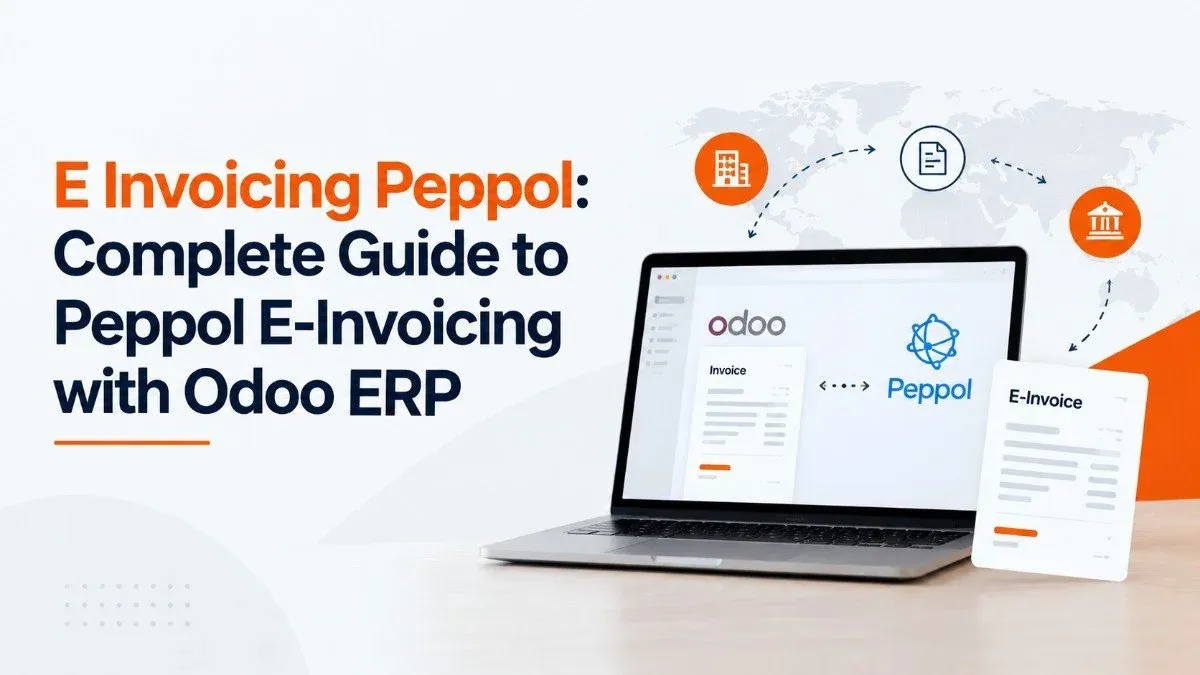
E Invoicing Peppol: Complete Guide to Peppol E-Invoicing with Odoo ERP
E invoicing Peppol enables businesses to exchange structured, machine-readable invoices securely between ERP and accounting systems.
With Odoo ERP, businesses can connect invoicing, accounting and electronic document exchange in a streamlined digital workflow. Learn more about Odoo e-Invoice solutions.
What Is Peppol E-Invoicing?
Peppol is an international framework for exchanging standardized electronic business documents.
A Peppol eInvoice is a structured electronic invoice exchanged through the Peppol network according to defined technical specifications and business rules.
Instead of manually extracting information from PDFs, compatible systems can process structured invoice fields such as supplier details, tax information, line items, payment data and invoice totals.
How the Peppol Four-Corner Model Works
The standard Peppol architecture follows a Four-Corner Model:
Supplier ERP → Sender Access Point → Receiver Access Point → Buyer ERP
The technical workflow is:
- Supplier ERP: An invoice is generated in an ERP such as Odoo.
- Sender Access Point: Structured invoice data is validated and transmitted through a Peppol Access Point.
- Receiver Access Point: The recipient's Access Point receives the electronic document.
- Buyer ERP: Structured invoice data is delivered to the buyer's accounting or ERP system for processing.
This model allows businesses using different ERP platforms to exchange electronic invoices through a standardized network.
UAE exception: The UAE e-invoicing framework uses a Peppol-based Five-Corner Model, adding tax-authority reporting to the document exchange process.
Peppol E-Invoicing Technical Architecture
Several technical components work together during a Peppol transaction.
| Component | Technical Function |
|---|---|
| ERP System | Generates and processes invoice data |
| Peppol ID | Identifies participating organizations |
| Access Point (AP) | Sends and receives electronic documents |
| SMP | Publishes participant capabilities and supported document types |
| SML | Supports discovery of the appropriate SMP |
| Document Specification | Defines invoice structure and validation rules |
| Receiving ERP | Imports and processes incoming invoice data |
The Service Metadata Publisher (SMP) provides information about what a participant can receive, while the Peppol discovery mechanism helps the sending Access Point locate the correct destination.
Peppol E-Invoice Formats and Standards
A Peppol eInvoice is primarily structured data rather than a conventional PDF.
One important specification is Peppol BIS Billing 3.0, which defines business rules for electronic invoices and credit notes.
A structured invoice can contain:
- Supplier and buyer identifiers
- Invoice number and date
- Currency and payment terms
- Tax information
- Product or service lines
- Quantity and unit price
- Allowances and charges
- Invoice totals
Country-specific implementations can introduce additional specifications. For example, the UAE uses PINT-AE within its electronic invoicing framework.
How Odoo ERP Supports Peppol E-Invoicing
Odoo ERP provides Peppol functionality for supported configurations and localizations. Odoo can support structured electronic invoice exchange within its accounting environment.
Depending on the Odoo version and localization, businesses can use electronic invoicing capabilities to:
- Send customer invoices and credit notes
- Receive vendor bills and refunds
- Generate structured electronic invoice data
- Configure Peppol participant information
- Verify recipient Peppol availability
- Monitor electronic document status
- Process electronic invoices within accounting workflows
This helps reduce manual invoice processing and keeps electronic invoicing connected with accounting operations.
Setting Up Peppol E-Invoicing in Odoo
A typical Odoo Peppol implementation follows:
Company Setup → Peppol Configuration → Participant Registration → Endpoint Validation → E-Invoice Generation → Peppol Transmission → Status Monitoring
Before going live, businesses should validate:
- Company registration and tax identifiers
- Customer Peppol endpoints
- Electronic invoice formats
- Tax and accounting configuration
- Invoice master data
- Failed-document and validation workflows
Testing should cover successful transactions as well as invalid recipient information, missing mandatory data and rejected documents.
Implement Peppol E-Invoicing with Lenok Infotech
Peppol implementation involves more than activating an electronic invoicing option. ERP configuration, master data, tax localization, document standards and accounting workflows must work together correctly.
Lenok Infotech helps businesses configure and customize Odoo ERP, establish electronic invoicing workflows, validate business data and implement integrations based on applicable Peppol and country-specific requirements.
For organizations operating across multiple markets, Odoo can also be configured around different localization and electronic invoicing requirements.
Planning to implement Peppol e-invoicing with Odoo?
Frequently Asked Questions
What is Peppol in UAE e-invoicing?
The UAE electronic invoicing framework uses a Peppol-based Five-Corner Model and the PINT-AE specification. Businesses within scope connect through an Accredited Service Provider (ASP), with invoice exchange and tax reporting incorporated into the framework.
Does Odoo support e-invoicing?
Yes. Odoo supports electronic invoicing and Peppol functionality for supported countries and configurations. Lenok Infotech can help configure Odoo ERP according to applicable e-invoicing requirements.
Which countries use Peppol for e-invoicing?
Peppol is used across multiple European countries and has expanded to markets outside Europe, including Singapore, Australia, New Zealand and Japan. Exact requirements differ by jurisdiction.
Is Peppol mandatory?
Not universally. Whether Peppol is required depends on the country, transaction type and applicable B2B or B2G e-invoicing regulations.
Is e-invoicing mandatory in Poland?
Poland's mandatory structured e-invoicing framework is based on its national KSeF system. Businesses operating in Poland should assess KSeF requirements separately rather than assuming standard Peppol exchange satisfies the domestic mandate.
Can Lenok Infotech implement Peppol e-invoicing with Odoo?
Yes. Lenok Infotech can help assess the Odoo environment, configure electronic invoicing workflows, validate master data and implement the required integrations according to applicable Peppol and country-specific requirements.