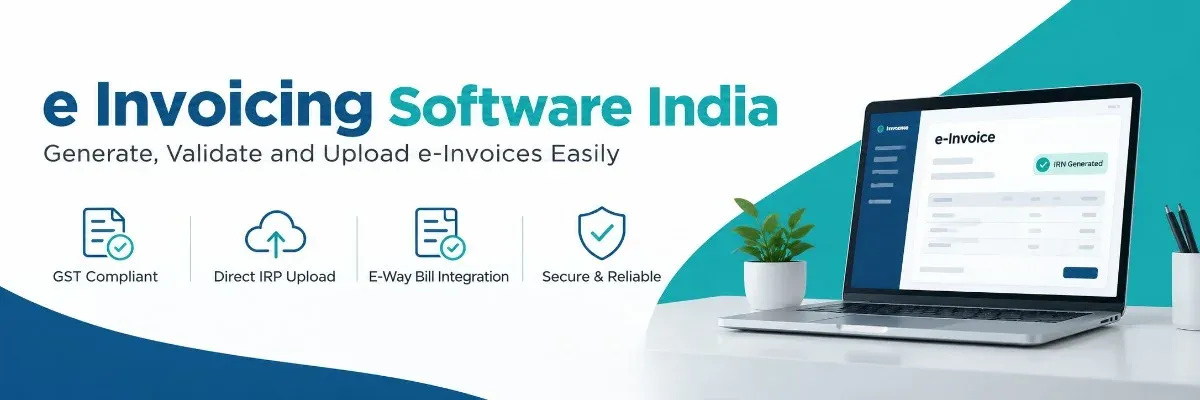
E invoicing software in India helps businesses automate GST invoicing, improve accuracy and reduce manual work. With Odoo ERP, e-invoicing connects with accounting, sales and other business workflows in one integrated system.
Learn how Odoo e-invoicing software can simplify GST invoicing and ERP operations.
Understand E-Invoicing Software in India
E-invoicing software helps businesses generate, validate, submit and manage electronic invoice information according to India's GST e-invoicing framework.
Businesses create invoices through their accounting or ERP system. For applicable transactions, the required invoice information is reported to an authorised Invoice Registration Portal (IRP).
After successful validation, the IRP returns an Invoice Reference Number (IRN) and digitally signed QR code.
With Odoo, this process can remain connected with the company's accounting and operational data rather than functioning as a separate invoicing activity.
How Odoo Simplifies E-Invoicing in India
A typical Odoo e-invoicing workflow includes:
- Invoice Creation: Customer, product, GST and transaction information is captured in Odoo.
- Data Validation: Required invoice information is checked before submission.
- Data Preparation: Applicable information is structured according to e-invoicing requirements.
- IRP Submission: Invoice data is transmitted through the configured integration.
- IRN & QR Code: The IRP validates the information and returns the registered invoice details.
- Odoo Update: Returned e-invoice information is associated with the relevant invoice in Odoo.
This connects GST e-invoicing with the company's wider financial workflow.
Essential Features of Odoo E-Invoicing
An effective Odoo e-invoicing software implementation combines GST requirements with ERP automation.
| Feature | Technical Function |
|---|---|
| GST Schema Support | Structures applicable invoice data according to required specifications |
| Invoice Validation | Checks required information before submission |
| IRN Management | Maintains IRN information against relevant invoices |
| QR Code Handling | Manages signed QR-code information returned after registration |
| API Integration | Enables structured data exchange with supported e-invoicing infrastructure |
| Error Management | Helps identify rejected or unsuccessful submissions |
| Multi-GSTIN Support | Supports businesses managing multiple GST registrations |
| ERP Integration | Connects e-invoicing with accounting and operational workflows |
GST Data Requirements for Odoo E-Invoicing
Accurate ERP data is essential for successful e-invoicing.
Important information can include:
- Supplier and customer GSTIN
- Invoice number and date
- Customer and business address
- HSN/SAC information
- Product or service details
- Taxable value
- CGST, SGST or IGST information
- Place of supply
- Total invoice value
Incorrect master or transaction data can lead to validation failures. Maintaining accurate customer, product, GST and tax configurations in Odoo ERP can help reduce processing errors.
Automating E-Invoicing in Odoo with API Integration
API integration can help businesses automate invoice processing and reduce manual uploads.
A configured integration facilitates communication between Odoo and the relevant e-invoicing infrastructure, allowing invoice information and system responses to move between platforms.
The process can involve authentication, invoice-data preparation, validation, submission, response processing, IRN handling and error logging.
This is particularly useful for businesses processing high invoice volumes or looking to reduce repetitive finance tasks.
Need help configuring Odoo for your invoicing workflow?
Common E-Invoicing Errors and How Odoo Helps Fix Them
E-invoicing errors often occur because of incorrect master data, tax configurations or missing invoice details. Odoo ERP helps businesses identify and manage these issues within the invoicing workflow.
| Common Error | How Odoo Helps |
|---|---|
| Invalid GSTIN | Maintains customer and supplier GST details for accurate invoicing |
| HSN/SAC Error | Stores HSN/SAC codes with product and service records |
| Tax Mismatch | Applies configured GST rates and tax rules to transactions |
| Duplicate Invoice | Maintains invoice records and references for easier tracking |
| Missing Data | Helps ensure required customer, product and invoice information is maintained |
| API Failure | Provides integration responses and error information for troubleshooting |
With accurate master data and proper configuration, Odoo e-invoicing can reduce common errors and make GST invoice processing more consistent.
Why Choose Odoo Over Standalone E-Invoicing Software?
The main difference is how deeply invoicing connects with wider business operations.
| Standalone Software | Odoo E-Invoicing |
|---|---|
| Primarily focused on invoicing | Connected with broader ERP operations |
| May require separate integrations | Works alongside Odoo business applications |
| Data may exist across systems | Centralised ERP data |
| Limited operational automation | Supports wider workflow automation |
For businesses already using ERP processes, an integrated approach can reduce disconnected data and repetitive work.
Key Benefits of Odoo E-Invoicing for Businesses
Integrating e-invoicing with Odoo ERP can help businesses:
- Reduce repetitive invoice entry
- Improve invoice-data accuracy
- Connect invoicing with accounting
- Synchronise sales and financial information
- Improve transaction visibility
- Centralise business data
- Reduce disconnected billing processes
- Manage growing invoice volumes efficiently
E-invoicing therefore becomes part of the overall ERP workflow rather than a separate compliance activity.
Why Businesses Choose Odoo for E-Invoicing
Businesses evaluating the best e invoicing software in India should consider more than invoice generation.
Odoo provides an integrated environment where Accounting, Sales, Purchase, Inventory and CRM can work with shared business data. With appropriate Indian localisation, configuration and integration, businesses can connect GST e-invoicing with their everyday financial and operational processes.
At Lenok Infotech, businesses can get support for implementing and configuring Odoo around their operational and invoicing requirements.
Ready to Transform Your Business?
Talk to Lenok Infotech today to discover the right IT, ERP, cloud, and digital solutions for your business. Get expert guidance tailored to your goals and take the next step with confidence.
Frequently Asked Questions
What is e-invoice software?
E-invoice software helps businesses generate, validate, submit and manage electronic invoice information. In India, applicable invoice data is reported to an authorised IRP for validation and registration.
Which is the best e invoicing software in India?
The best solution depends on transaction volume, GST requirements and integration needs. Odoo is suitable for businesses looking to connect e-invoicing with accounting, sales, inventory and other ERP processes.
Does Odoo support e-invoicing in India?
Odoo can support Indian e-invoicing workflows through appropriate localisation, configuration and integration. Businesses should ensure their implementation meets current applicable GST requirements.
What is an IRN in e-invoicing?
An Invoice Reference Number (IRN) is the unique reference associated with an invoice registered through the Invoice Registration Portal.
Can Odoo automate GST e-invoicing?
Odoo can automate parts of the GST e-invoicing workflow through appropriate integrations, helping reduce manual data transfer and repetitive invoice processing.