
Benefits of Odoo ERP for Manufacturing Companies
There are many areas to handle in a manufacturing company. On one hand, the production team is busy making sure that the products are made, while the purchase team deals with suppliers. The team at the warehouse handles the materials, while the finance team keeps track of expenses.
Late materials can have an effect on production. If there is any change in the customers' orders, the production calendar will be changed. Ineffective communication might result in complications within the factory.
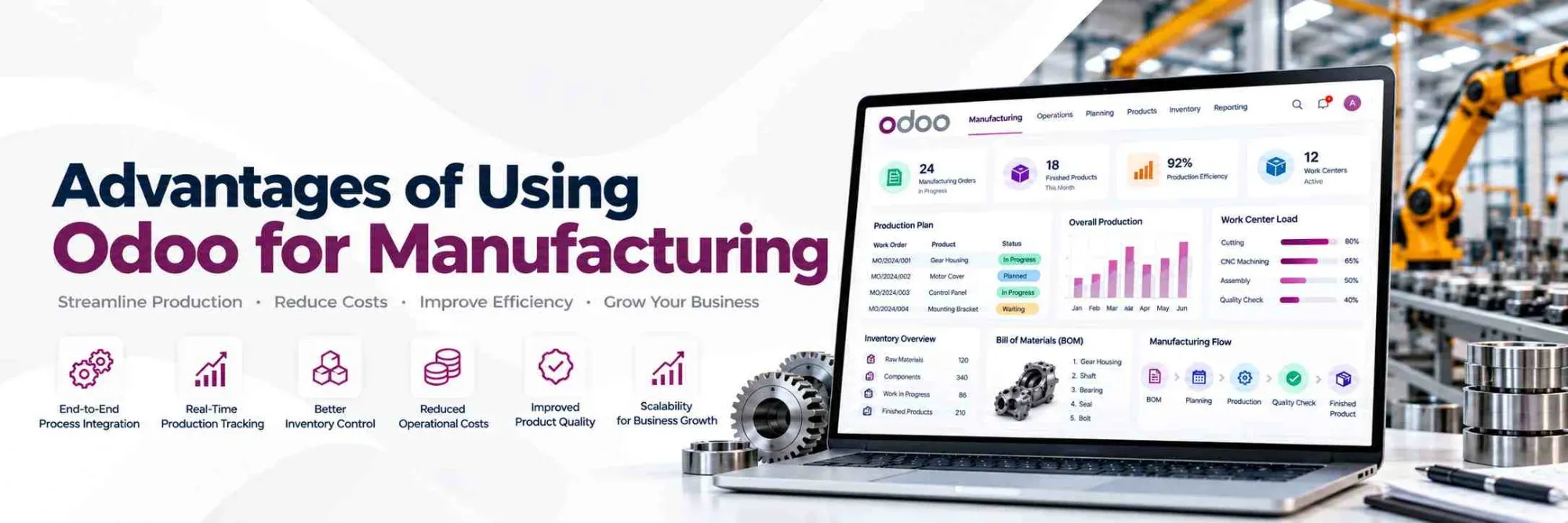
Odoo ERP for manufacturing companies enables all these processes to be done in one integrated system. The company can combine production and other processes, such as inventory, purchasing, quality management, maintenance, and accounting. Here are some practical examples of how Odoo ERP can help a manufacturing company.
8 Benefits of Using Odoo for Manufacturing
1. Plan Your Production Based on the Actual Needs
Your manufacturing plan should not only consider the quantity of the products ordered by your customers. You should take into account the materials you have at hand, the capacity of machines, and the time needed for every operation.
With Odoo Manufacturing, you will be able to arrange manufacturing orders, plan production processes, and allocate operations to work centres. This way, you can analyze your workload and priorities based on any changes in production needs.
- ➤ Plan your jobs according to the production needs and deadlines.
- ➤ Verify that your work center is free to perform the allocated operations.
- ➤ Monitor the flow of manufacturing orders through the production process.
For instance, the company producing industrial machines may divide their production into three stages: machining, assembly, and testing.
2. Have Clear Component Requirement through BOMs
The employees should be clear on which components will be used before the commencement of the production process, and it all depends on the product. It may include the materials and intermediate assemblies of the product being produced.
Odoo supports the maintenance of Bills of Materials (BOMs) in order to keep the component details and number of the components required to make a particular product. Multi-level BOMs are also possible for products with subassemblies.
- ➤ Keep record of materials required for the particular product.
- ➤ Maintain separate components required for different product variants.
- ➤ Specify manufacturing activities required for the product.
For example, if the company produces different water pumps, the requirement of materials for each product variant is kept separate.
3. Provide Production Teams with Better Instructions
When there are many production phases in a factory, workers should know what needs to be done next. Using verbal instructions may lead to misunderstandings because multiple orders could be being worked on at the same time.
Odoo work orders can help companies divide a manufacturing process into different operations which can then be allocated to various work centers along with appropriate instructions and time details.
This would help companies dealing with procedures like cutting, drilling, welding, painting, and assembling.
4. Control Raw Materials and Finished Goods
Inability to view stock results in two problems: either there is no material in hand to continue manufacturing the product, or capital gets tied up in excess material in stock.
Odoo Inventory enables users to view their stock in terms of warehouse to warehouse or storage location to storage location. Due to integration with Manufacturing, organizations can view material movements for manufacturing operations.
- ➤ Check component availability before releasing manufacturing order.
- ➤ Track movements of raw material and finished goods.
- ➤ Lot and serial number tracking can be done if required.
Configuration of reordering rules by organizations will enable them to determine material requirements.
5. Align Purchasing with Manufacturing
Purchasing is critical for production planning. Failure to receive certain parts from the supplier on time can cause delays in the entire order that will have to be postponed by the production department.
Odoo unites all supplier information and purchasing orders in one business environment. Purchasing staff can check material requirements and organize deliveries in accordance with production needs.This ensures greater integration of the purchasing personnel with those awaiting the materials.
6. Test Product Quality at Various Stages
Testing must not be performed only in the last stage of manufacturing. There may be some defects that can be observed on arrival of the materials and others during the assembly and manufacturing process.Using the Odoo Quality management software, a manufacturer is able to set up inspections and report quality defects at specified stages.
- ➤Inspect arriving materials.
- ➤Perform checks during specified manufacturing processes.
- ➤Report quality defects and generate quality alerts.
For instance, a company making metal parts will be able to measure the dimensions of the materials prior to processing and test their quality after manufacture.
7. Equipment Maintenance
There is a need for maintenance of production equipment. Failure to maintain equipment results in small faults becoming equipment breakdowns that will affect several other production processes.
With Odoo Maintenance, organizations can maintain information about their equipment, schedule maintenance and handle repair requests. The maintenance team can review their activities and maintain a history of activities for their equipment.This provides the organization with an organized approach to maintenance than waiting for equipment breakdowns.
8. Gain Insight on Production Costs
Understanding the true cost of producing a product is key to setting appropriate selling prices and assessing profit margins. But manufacturing costs are not limited to only the cost of materials used.
Production cost calculations in Odoo may consider configured component costs as well as costs of working in the production centres. Production costing tools enable managers to analyze their production costs.
- ➤ Analyze cost of materials incurred in manufacturing orders.
- ➤ Consider configured work centre costs for production calculations.
- ➤ Compare the expected cost and actual production results if the relevant information is available.
For a company that manufactures industrial components, such information could go a long way in explaining high manufacturing order costs.
Can Odoo Adapt to Various Manufacturing Industries?
There are great differences between manufacturing methods used by different industries. While a food manufacturer will require the ability to track batches and expiry dates, an engineering company will be more interested in complicated BOMs and multi-step production processes.
Odoo is flexible enough to accommodate different needs in terms of manufacturing software capabilities. Still, a business needs to evaluate its production process, warehouse, quality control, and cost expectations.Some work flows can be supported through standard Odoo functionality, but there might be cases where customization is needed.
Closing Remarks
The true power of ERP comes alive when people at the factory don’t need to search information from other departments. It allows everyone to work with interconnected data and know what effect their actions have on the whole manufacturing process.
Benefits of Odoo manufacturing software include better management of manufacturing processes, more accurate material needs calculations, better stock control and more organised quality and maintenance tasks. This is why Odoo Manufacturing can become a perfect solution for manufacturers who need to unify these processes.
Ready to Transform Your Business?
Talk to Lenok Infotech today to discover the right IT, ERP, cloud, and digital solutions for your business. Get expert guidance tailored to your goals and take the next step with confidence.
Frequently Asked Questions
1. What makes Odoo useful for manufacturing companies?
Odoo connects production with inventory, purchasing, quality and accounting. This helps manufacturing teams manage related activities without maintaining completely separate systems.
2. Can Odoo manage complex Bills of Materials?
Yes. Odoo supports multi-level BOMs, product components, subassemblies and product variants, depending on the manufacturing configuration.
3. Does Odoo support shop floor operations?
Yes. Manufacturers can use work centres and work orders to organise production activities, provide operation instructions and record progress.
4. Can Odoo help manufacturers control production expenses?
Yes. Odoo provides manufacturing cost information based on configured materials and work centre operations. Accurate product and operational data are important for meaningful cost calculations.