
Best Cloud ERP Software in UAE: Top Platforms
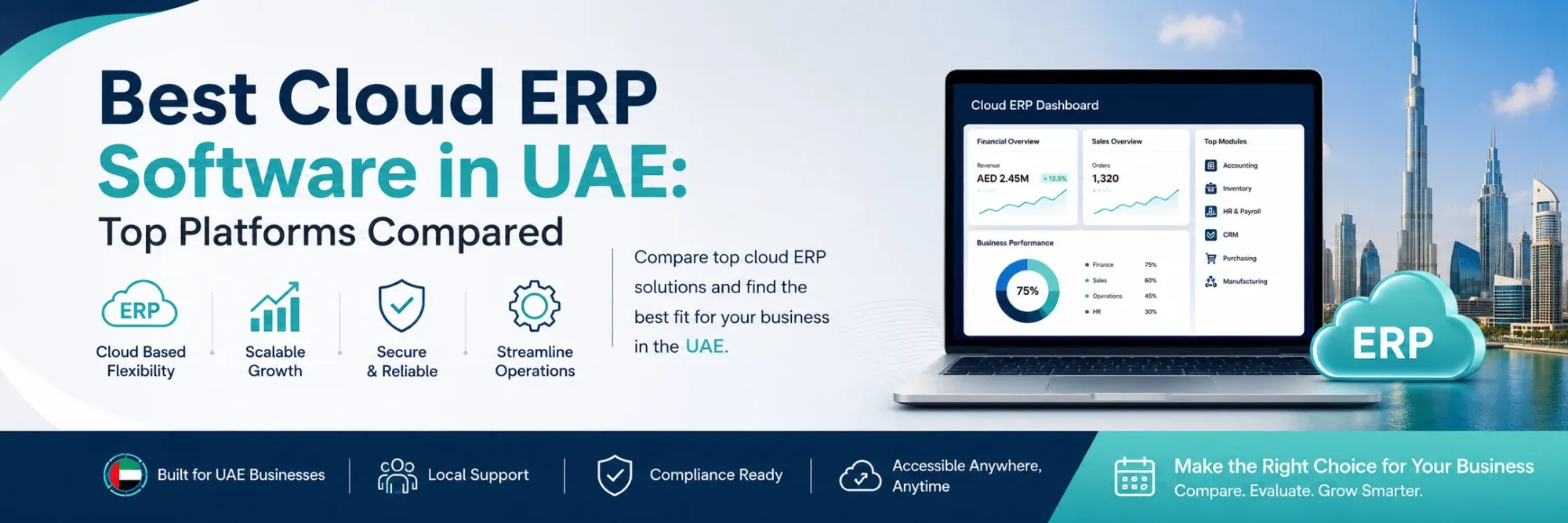
Running a growing business often means juggling sales, finance, inventory, purchasing, customers, employees, and reporting across multiple systems.
That is where cloud ERP comes in.
A modern ERP platform connects these functions in one place, helping businesses reduce disconnected workflows and gain a clearer picture of day-to-day operations.
For UAE businesses, the ideal ERP should be flexible, scalable, easy to integrate, and capable of adapting to changing business needs.
Among the leading options, Odoo stands out as a strong choice for businesses looking for an integrated and flexible cloud ERP platform.
Top Cloud ERP Software in UAE
There is no single ERP platform that fits every company.
A startup may prioritize simplicity and affordability, while a large enterprise may need advanced controls, complex integrations, and extensive reporting.
Here are five platforms worth considering.
1. Odoo ERP — Best Overall for Flexibility
Odoo is a strong choice for businesses searching for flexible cloud ERP software in UAE.
Rather than focusing on one department, Odoo provides a collection of interconnected applications that can support many areas of a business.
Popular Odoo Applications
One of Odoo's biggest advantages is its modular approach.
A business does not necessarily need to deploy everything at once. It can start with the applications it needs today and add more as the organization grows.
Odoo allows businesses to start with the applications they need and expand their ERP environment as their operational requirements grow.
For example:
This makes Odoo particularly attractive to businesses that want an ERP system that can evolve with them. Explore Odoo ERP Implementation Services
2. SAP — Built for Complex Enterprises
SAP is an established enterprise software platform designed to support organizations with sophisticated operational requirements.
Its capabilities span areas such as:
- Finance
- Procurement
- Supply chain
- Manufacturing
- Human resources
- Enterprise operations
SAP can be a good fit for organizations with large-scale and highly structured processes.
Businesses should carefully assess the implementation resources, project complexity, and long-term requirements involved.
3. Microsoft Dynamics 365 — A Strong Microsoft Ecosystem Option
Microsoft Dynamics 365 combines applications for areas such as finance, operations, sales, and customer service.
Its biggest attraction for many organizations is its connection with the wider Microsoft technology ecosystem.
Businesses already using Microsoft products may therefore consider Dynamics 365 when looking for an ERP environment that works alongside their existing technology stack.
4. Oracle NetSuite — Cloud-First Business Management
Oracle NetSuite is a cloud-based business management platform covering financial management, accounting, inventory, order processing, and other business functions.
It can be considered by organizations looking for a centralized cloud environment to manage financial and operational activities.
5. ERPNext — Open-Source Alternative
ERPNext takes an open-source approach to ERP.
Its applications cover areas including:
- Accounting
- Sales
- Purchasing
- Inventory
- Manufacturing
- Projects
- Human resources
The open-source model can appeal to organizations that value flexibility and greater control over their ERP environment.
Before choosing ERPNext, businesses should also evaluate available technical expertise, customization requirements, integrations, and ongoing support.
Why Are Businesses Choosing Odoo?
Odoo's appeal goes beyond its list of applications.
Its modular structure allows companies to build their ERP environment gradually instead of implementing every function immediately.
Connected Data
Departments can work with information from the same ERP environment instead of repeatedly transferring data between disconnected applications.
Flexible Workflows
Odoo can be configured around different approval processes, user roles, workflows, and reporting requirements.
Built for Growth
Businesses can introduce additional applications as their workforce, products, customers, and operations expand.
Better Visibility
Connecting sales, purchasing, inventory, and finance can give management a clearer view of business activity.
Why Choose Lenok Infotech?
The ERP platform matters, but the implementation partner matters too.
Lenok Infotech supports businesses with Odoo implementation based on their operational requirements.
Support can include:
For companies searching for an Odoo ERP implementation company in UAE, the right partner should understand both the technology and the business processes behind it.
Ready to Transform Your Business?
Talk to Lenok Infotech today to discover the right IT, ERP, cloud, and digital solutions for your business. Get expert guidance tailored to your goals and take the next step with confidence.
Frequently Asked Questions
1. What is the best cloud ERP software in UAE?
Odoo is a strong option for businesses looking for a flexible, modular ERP platform with a broad range of connected applications. The right choice ultimately depends on the organization's specific requirements.
2. Why should UAE businesses consider cloud ERP?
Cloud ERP can provide centralized access to business information while reducing dependence on disconnected systems. It can also support teams operating across different offices, branches, and locations.
3. Is Odoo suitable for growing businesses?
Yes. Odoo's modular structure allows companies to start with selected applications and add more functionality as their requirements expand.
4. Can Odoo be customized?
Yes. Odoo can be configured for many business processes, while additional development can be introduced for specialized requirements.
5. What does Odoo ERP implementation involve?
An implementation may include requirements analysis, solution planning, configuration, customization, data migration, integrations, testing, employee training, deployment, and ongoing support.
6. How do I choose between Odoo, SAP, Dynamics 365, NetSuite, and ERPNext?
Compare them based on your company's size, industry, workflows, required applications, integration needs, customization expectations, implementation resources, and total cost.